
12 Eye-Opening Recycling Facts and Statistics for 2025

Waste generation is at an all-time high, and the way we manage it continues to evolve in response to global challenges. As of 2026, we’re seeing an accelerating need for innovation in how we recycle materials, especially electronic waste (e-waste).
Every discarded device, plastic bottle, or food wrapper represents more than just waste. It’s a lost opportunity to recover valuable materials, reduce pollution, and contribute to economic growth.
For businesses, efficient recycling doesn’t only make sense for the environment, it can cut costs, streamline supply chains, and open up new markets. For individuals, being informed about how waste is handled and choosing more sustainable options helps reduce our environmental footprint and improve global health.
As we take on the challenges, understanding the full scale of the global waste problem and the state of recycling in 2026 is more important than ever. This blog will discuss the latest facts and statistics on recycling, highlighting why it’s crucial to stay ahead of the curve in addressing e-waste and other waste management challenges.
Why This Matters for Businesses in 2026
|
Top Recycling Facts and Statistics for 2026
Here are the top facts and statistics that highlight where we stand, what’s at stake, and why recycling, especially e-waste recycling, needs urgent attention
1. The World is Producing More Waste Than Ever
Waste generation is at an all-time high, and it’s only getting worse. Every year, the world produces billions of tons of waste, with projections indicating that by 2050, global waste production will reach 3.8 billion metric tons. This surge is driven by overconsumption, rapid urbanization, and an economy built on short-lived, disposable products rather than durable, repairable goods.
In 2020, the world spent an estimated $252 billion on waste management, but the actual cost is far higher. When accounting for the hidden impacts, including pollution, health issues, and climate damage from improper waste disposal, the total rises to $361 billion.
Without urgent advancements in waste management and recycling infrastructure, this figure is projected to nearly double to $640.3 billion annually by 2050, placing an even more significant financial and environmental burden on economies worldwide.
2. Most Products Are Not Designed for Recycling
The design of many products today doesn’t support recycling. Smartphones, laptops, and appliances often use non-recyclable materials, glued components, and mixed plastics, making recycling costly and inefficient. Some devices are designed with sealed-in batteries, while others are created with materials that can't be easily separated for recycling. This makes it difficult for recycling centers to recover valuable components.
For example, food and beverage packaging. like coffee cups with plastic linings, are often labeled recyclable, but can’t be processed effectively by most facilities.
As we move into 2026, manufacturers are being called to prioritize circular design: modular products, easy-to-recycle materials, and take-back programs. This shift will be critical to making recycling a fully effective waste management solution.
3. E-waste is the Fastest-Growing Waste Stream
Electronic waste continues to outpace every other waste stream worldwide. A record 62 million metric tonnes (Mt) of e-waste were generated globally in 2022, an 82% increase since 2010. Current trends indicate volumes are on track to rise another 32%, reaching 82 million metric tonnes by 2030, according to the Global E-waste Monitor 2024.
Notably, just 1% of global rare-earth element demand is currently met through e-waste recycling, underscoring a missed opportunity to reduce dependence on primary mining for critical materials.
As device ownership expands and product lifecycles shorten, the gap between e-waste generation and formal recycling capacity continues to widen, making scalable, compliant recycling systems a strategic priority in 2026.
4. Less than a Quarter of E-Waste is Properly Recycled
Despite the sheer volume of e-waste generated yearly, only 22.3% is officially documented as collected and properly recycled. That means the vast majority, nearly 78%, ends up illegally dumped, burned, or informally processed in ways that harm both the environment and human health.
The issue isn’t just about improper disposal; it’s about a broken system that fails to collect, process, and repurpose e-waste effectively. Many countries lack the infrastructure to handle the growing flood of discarded electronics, and even in regions with e-waste recycling programs, they are often underfunded, inefficient, or inaccessible to the average consumer.
One of the most significant obstacles is low consumer awareness. Many people don’t know where or how to recycle old electronics, leading them to hoard unused devices or throw them in the trash, ultimately ending up in landfills.
5. E- waste contains Billions of Dollars in Valuable Materials
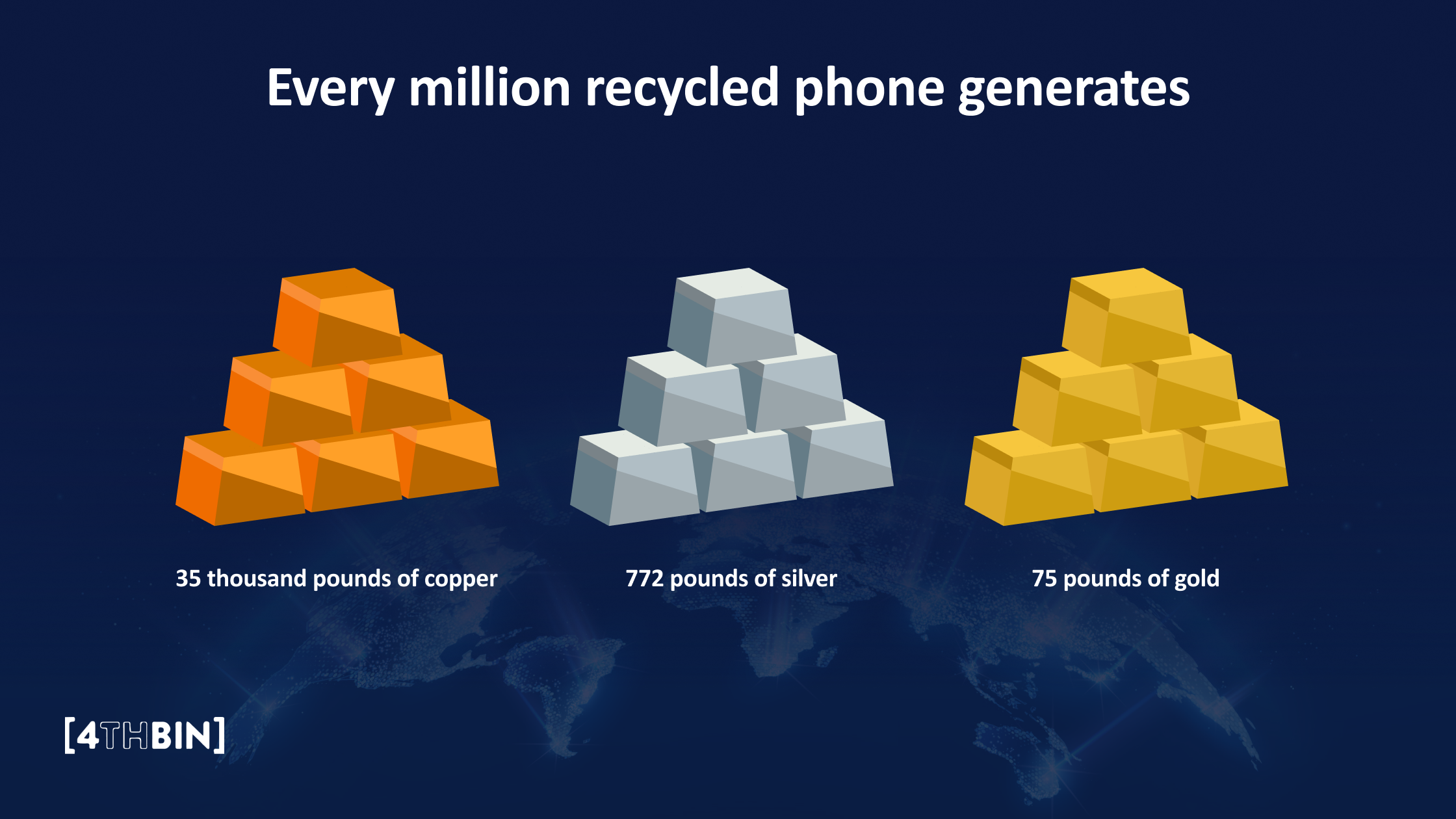
E-waste is also a massive economic opportunity that is largely being wasted. Discarded electronics contain an estimated $57 billion in recoverable materials annually, including gold, silver, copper, palladium, and rare-earth metals.
In fact, 35,000 pounds of copper, 772 pounds of silver, 75 pounds of gold, and 33 pounds of palladium can be recovered from every million recycled cell phones.
Yet, due to inefficient collection and recycling systems, most of these valuable resources are lost to landfills or incinerated rather than recovered and reused.
To put this into perspective, one metric ton of circuit boards contains up to 100 times more gold than a metric ton of mined gold ore. This means that if e-waste were fully recycled, it could significantly reduce the need for environmentally destructive mining operations, which cause deforestation, water pollution, and habitat destruction.
However, because global e-waste recycling rates remain so low, most valuable materials are still wasted. Without stronger collection programs, corporate responsibility initiatives, and improved consumer awareness, we pollute the environment and throw away billions of dollars in recoverable resources annually.
6. Recycling Varies Significantly Across Countries
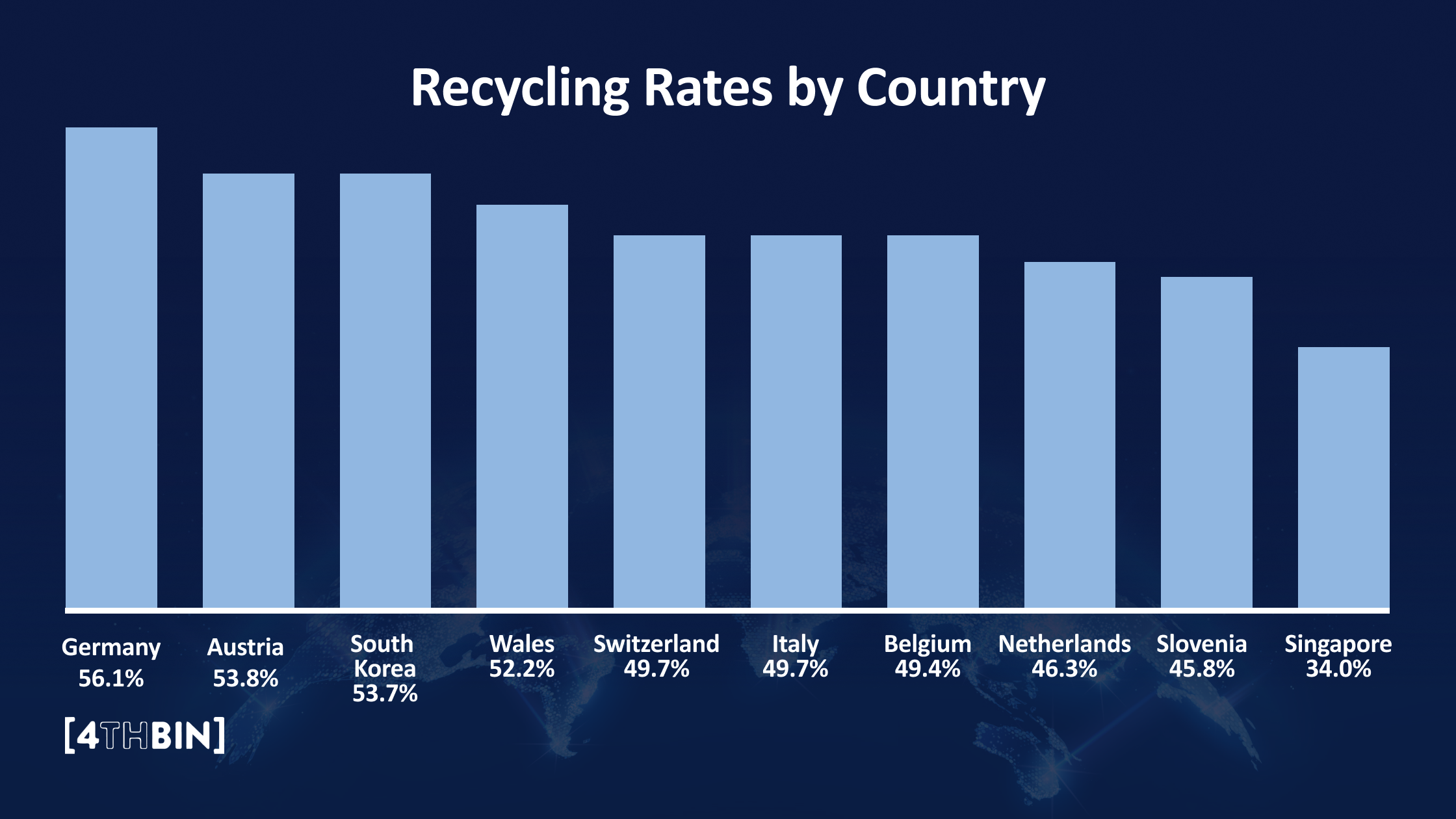
Recycling performance differs significantly across developed economies, reflecting major differences in policy design, infrastructure investment, and system accountability. According to the Global Waste Index 2025, which evaluates municipal solid waste generation and treatment across 38 OECD countries, disparities remain substantial even among high-income nations.
South Korea currently reports one of the highest municipal recycling rates among OECD countries at approximately 54%, while Germany recycles around 45% and Austria approximately 42% of municipal waste. These countries operate under structured Extended Producer Responsibility (EPR) systems, nationwide collection programs, and established Deposit Return Schemes (DRS), contributing to stronger material recovery outcomes.
In contrast, the United States generates the highest municipal waste per capita among OECD nations, approximately 951 kilograms per person annually, yet recycles only about 30% of that total. Nearly half of U.S. municipal waste is still landfilled. Unlike many European economies, the U.S. does not operate under a unified federal recycling mandate, resulting in fragmented state-level policies and uneven program performance.
7. The Global Circularity Rate is Declining
The concept of a circular economy, in which materials are reused, repurposed, and recycled rather than discarded, has been promoted as the most effective way to reduce waste and minimize environmental damage. However, despite global efforts, the circularity rate is declining, meaning more raw materials are being extracted than reused. Over the past five years, the global circularity rate has dropped by 21%, indicating an increased reliance on virgin materials rather than recycled ones.
This decline is mainly due to inefficiencies in waste management, weak recycling infrastructure, and the rising complexity of consumer products. Many modern products, especially electronics, are designed to make them difficult to dismantle or recycle, with components glued, soldered, or mixed with non-recyclable materials. This makes it harder to extract and repurpose valuable materials into new products, leading to a higher demand for freshly mined resources.
8. A Significant Share of Waste Still Goes to Landfill
Despite decades of recycling programs and public awareness campaigns, landfilling remains a dominant waste management pathway in the United States.
According to the U.S. Environmental Protection Agency (EPA):
- The U.S. generated 292.4 million tons of municipal solid waste (MSW)
- Only 32.1% was recycled or composted
- 11.8% was combusted with energy recovery
- Approximately 50% (146 million tons) was sent to landfills
This means that half of all municipal waste in the U.S. continues to be buried rather than recovered for reuse.
Food waste alone accounted for 63.1 million tons of MSW generation in 2018, making it one of the largest material categories. Plastics represented 35.7 million tons, yet only about 9% of plastics were recycled, highlighting ongoing challenges in material recovery
.
While electronics represent a relatively small percentage of total MSW by weight (approximately 2.7 million tons of selected consumer electronics in 2018), improper disposal remains a concern. Electronics require specialized recycling systems due to hazardous components and recoverable metals, yet access to collection programs varies widely by municipality..
9. The Biggest Contributors to the E-Waste Crisis
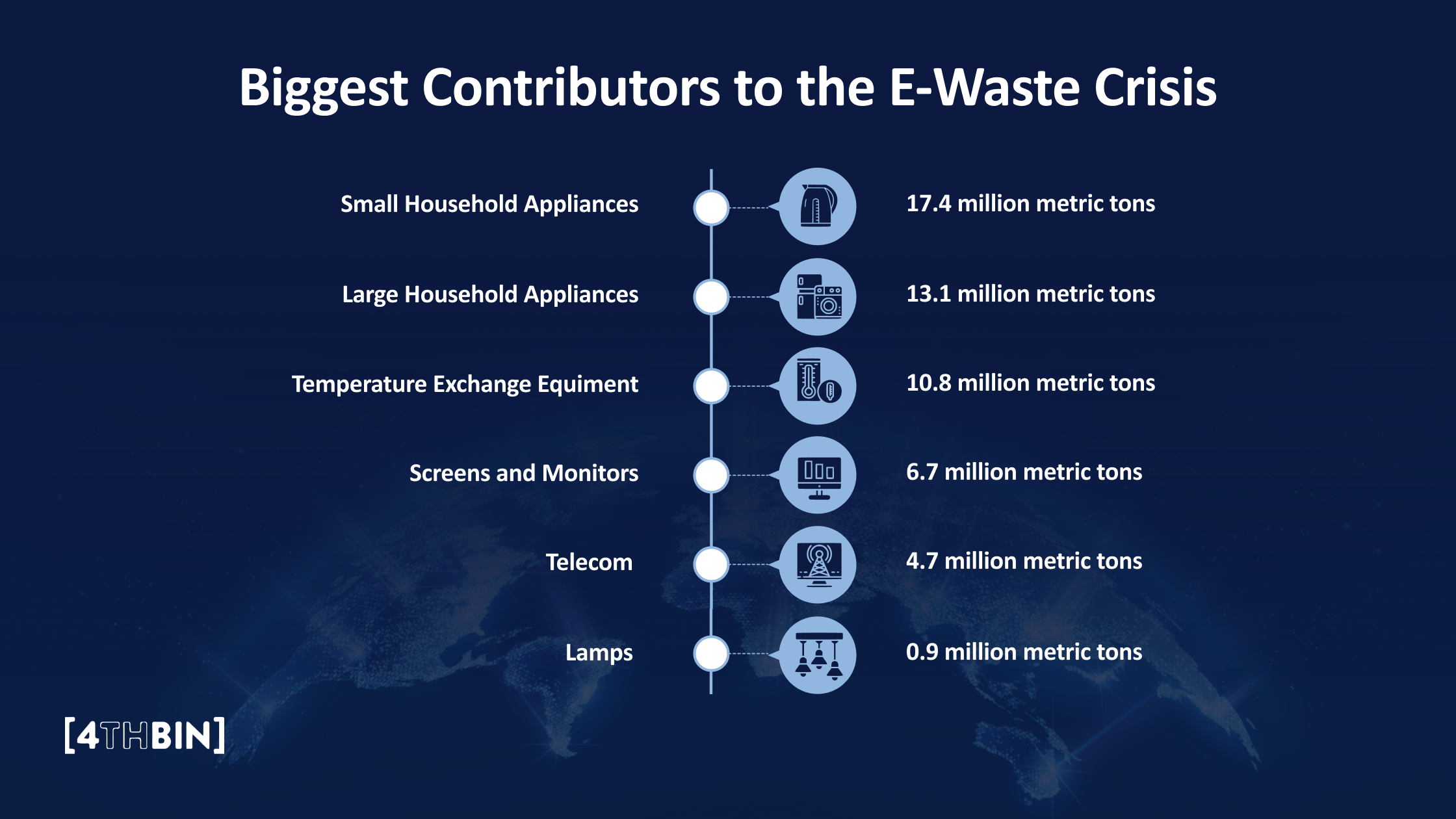
According to the Global E-Waste Monitor 2024, the world generated 62 million metric tons of electronic waste in 2022, the highest level ever recorded. If current trends continue, global e-waste is projected to reach 82 million metric tons by 2030, underscoring the urgency of scalable, compliant recycling infrastructure.
The latest verified breakdown shows that e-waste is driven primarily by the following categories:
- 20.4 million metric tons — Small equipment (Microwaves, vacuum cleaners, kettles, power tools, small household electronics)
- 13.1 million metric tons — Large equipment (Washing machines, dryers, dishwashers, stoves)
- 10.8 million metric tons — Temperature exchange equipment (Refrigerators, freezers, air conditioners, heat pumps)
- 7.0 million metric tons — Screens and monitors (Televisions, computer monitors, laptops, tablets)
- 5.0 million metric tons — Small IT and telecommunications devices (Mobile phones, routers, keyboards, e-readers)
- 0.9 million metric tons — Lamps and lighting equipment (Fluorescent bulbs, LEDs, mercury-containing lamps requiring specialized recycling)
Notably, small equipment represents the largest share of global e-waste, reflecting the rapid turnover of consumer electronics and compact household devices.
2026 Leadership PerspectiveWhile public attention often focuses on smartphones and laptops, the data shows that everyday household appliances and small equipment contribute the largest volume of global e-waste by weight. For organizations and municipalities in 2026, this presents three critical imperatives:
As global volumes accelerate, organizations that implement structured, compliant, and transparent recycling programs will be better positioned to manage regulatory risk, protect data security, and support circular economy goals. |
10. E-waste is Now a Major Health Concern
E-waste is now a growing public health crisis. As more electronic devices are discarded improperly, toxic chemicals and heavy metals from these devices pollute the air, soil, and water, leading to serious health risks.
As mentioned earlier, global e-waste is projected to exceed 72.4 million metric tons in 2026, yet only over 20% is officially collected and recycled. The rest often ends up in landfills, incinerators, or informal recycling operations, exposing millions of people, especially those in developing countries, to hazardous substances.
Electronics contain a range of harmful materials that, when not properly disposed of, can have long-term health effects:
- Lead and Mercury: Found in circuit boards and screens, these metals can cause neurological damage, particularly in children, and have been linked to developmental disorders.
- Cadmium: Used in rechargeable batteries, cadmium exposure has been associated with lung disease and kidney damage.
- Brominated Flame Retardants: Commonly used in plastics, these chemicals can disrupt hormone function and affect brain development.
According to the World Health Organization’s global e-waste health report, exposure to informal recycling toxins increases cancer and neurological risks in children. Especially in countries where informal recycling, such as burning or acid-stripping electronic components, is common.
These health risks are most severe in the informal e-waste recycling sector, particularly in Africa, South Asia, and Latin America. Workers, including children, manually dismantle electronics without protective gear, breathing in toxic fumes and handling contaminated components. Studies show that children exposed to e-waste processing areas have higher levels of lead in their blood, which can lead to cognitive impairment and developmental delays.
11. E-Waste Legislation is Lacking Globally
E-waste is one of the fastest-growing waste streams globally, yet regulatory coverage remains inconsistent. According to the Global E-waste Monitor 2024 (UNITAR/ITU), 81 countries have enacted national e-waste legislation, up from 78 in 2019. However, only 67 of those countries have formal frameworks that include Extended Producer Responsibility (EPR) provisions, meaning large parts of the world still lack structured, enforceable systems for managing electronic waste.
Even in developed markets, fragmentation persists. In the United States, e-waste regulation is handled at the state level rather than through a unified federal mandate. The National Conference of State Legislatures (NCSL) notes that recycling laws vary significantly by state, creating uneven compliance requirements for businesses.
Where regulation is weak or enforcement is limited, e-waste is more likely to be mismanaged or processed through informal recycling channels, increasing environmental and public health risks, as highlighted by the International Telecommunication Union (ITU).
Strengthening global e-waste governance will require broader legislative adoption, stronger enforcement, and expanded producer responsibility systems to ensure safe and accountable recycling practices.
12. The Urgent Need for Better Recycling Infrastructure
Recycling is often promoted as a solution to the world’s waste problem. Still, without efficient and accessible infrastructure, it remains an underutilized and ineffective system in many parts of the world. General waste and e-waste recycling face gaps in collection, processing, and enforcement, making it challenging to keep valuable materials in circulation and prevent environmental harm.
Despite efforts to increase recycling rates, much of what could be recycled never reaches the proper facilities. Issues such as a lack of curbside collection programs, contamination of recyclables, and inadequate sorting technology mean that millions of tons of plastic, paper, glass, and metal still end up in landfills or incinerators yearly.
The lack of proper infrastructure is even more pronounced for e-waste, which requires specialized processing due to its mix of valuable metals and hazardous components. Many countries lack dedicated e-waste collection programs, forcing consumers to improperly hoard or dispose of old electronics.
Even when e-waste is collected, many facilities lack the advanced technology to safely extract reusable materials, leading to inefficient recovery rates and increased reliance on raw material extraction.
For recycling to be effective, general waste and e-waste recycling need significant investment and reform. This includes:
- Expanding collection systems to ensure recyclables and electronics are properly disposed of.
- Investing in advanced recycling technology to improve material recovery rates.
- Stronger regulations and enforcement to hold manufacturers accountable for end-of-life product disposal.
- Public education campaigns to reduce contamination in recycling streams and increase participation.
Recycling is only as effective as the infrastructure that supports it. Without urgent improvements in waste management systems worldwide, general waste and e-waste will continue to overwhelm landfills, waste valuable resources, and contribute to environmental and health crises.
13. The Recycling Industry is a Lucrative Market
Recycling isn’t just good for the environment; it’s a powerful economic driver. When managed effectively, it creates jobs, generates tax revenue, reduces manufacturing costs, and strengthens domestic supply chains.
According to the U.S. EPA’s Recycling Economic Information (REI) Report:
- Recycling and reuse activities in the United States support 757,000 jobs
- Generate $36.6 billion in wages
- Contribute $6.7 billion in annual tax revenues
- On average, every 1,000 tons of recycled material supports 1.57 jobs
The economic impact extends beyond the U.S.:
- Transitioning toward a greener, more circular economy could create 24 million new jobs globally by 2030.
- Proper e-waste recycling can unlock billions of dollars in recoverable materials, reducing dependence on costly raw material extraction
These figures demonstrate that investing in recycling infrastructure and responsible e-waste management isn’t just an environmental commitment; it’s a strategic financial opportunity for businesses, governments, and communities.
4THBIN: Your Trusted Partner in Responsible E-Waste Recycling

At 4THBIN, we are committed to driving forward sustainable e-waste recycling practices in 2026 and beyond. As an R2v3-certified and NYS DEC-registered recycling facility, 4THBIN follows strict environmental, worker safety, data security, and downstream due diligence protocols.
Organizations working with certified recyclers receive documented chain-of-custody, audit-ready reporting, and verified downstream accountability, critical for ESG reporting and regulatory compliance in 2026.
Since our inception, we’ve helped more than 10,000 organizations, including global Fortune 100 companies, properly dispose of their e-waste, ensuring that both the environment and their data remain secure. Through our RemoteReturn services, we offer seamless solutions for companies looking to safely and efficiently dispose of outdated electronics.
We pride ourselves on creating customized solutions that align with your unique needs. Whether you’re an individual or a corporation, we make it easy to recycle responsibly. Reach out to 4THBIN today to start your sustainable e-recycling journey.
Frequently Asked Questions
1. What’s the difference between regular recycling and e-waste recycling?
Regular recycling usually covers materials like paper, cardboard, glass, and some plastics. E-waste recycling is different because electronics contain hazardous components (such as heavy metals) and valuable materials (such as copper, gold, and rare earths) that require specialized handling, certified processes, and documented downstream tracking.
2. Why is e-waste growing so fast in 2026?
E-waste is rising due to shorter device lifetimes, frequent upgrades, repair limitations (sealed parts, glued components), and increased device ownership across households and businesses. Many products are replaced before they stop working, which accelerates disposal volumes.
3. What happens if e-waste isn’t recycled properly?
Improper e-waste disposal can lead to toxic pollution (air, soil, and water contamination), health risks in informal recycling sectors, and loss of recoverable resources. It also increases business risk if old devices still contain sensitive data that isn’t securely destroyed.
4. How can businesses improve recycling outcomes beyond “just collecting waste”?
Businesses can raise recycling performance by:
- Running periodic electronics collection drives (devices, cables, accessories)
- Choosing certified recyclers with clear chain-of-custody tracking
- Prioritizing reuse/refurbishment before recycling
- Using take-back programs and partnering with vendors that support circular design
- Requesting reports and documentation for ESG/CSR and compliance needs
5. Why should I choose an R2v3-certified recycler like 4THBIN?
R2v3 certification helps ensure that e-waste is handled in accordance with strong standards for environmental protection, worker safety, data security, and downstream accountability. Choosing an R2v3-certified recycler like 4THBIN adds transparency and confidence that your electronics are processed responsibly, especially important for businesses managing large volumes of retired equipment.


